What is good design?

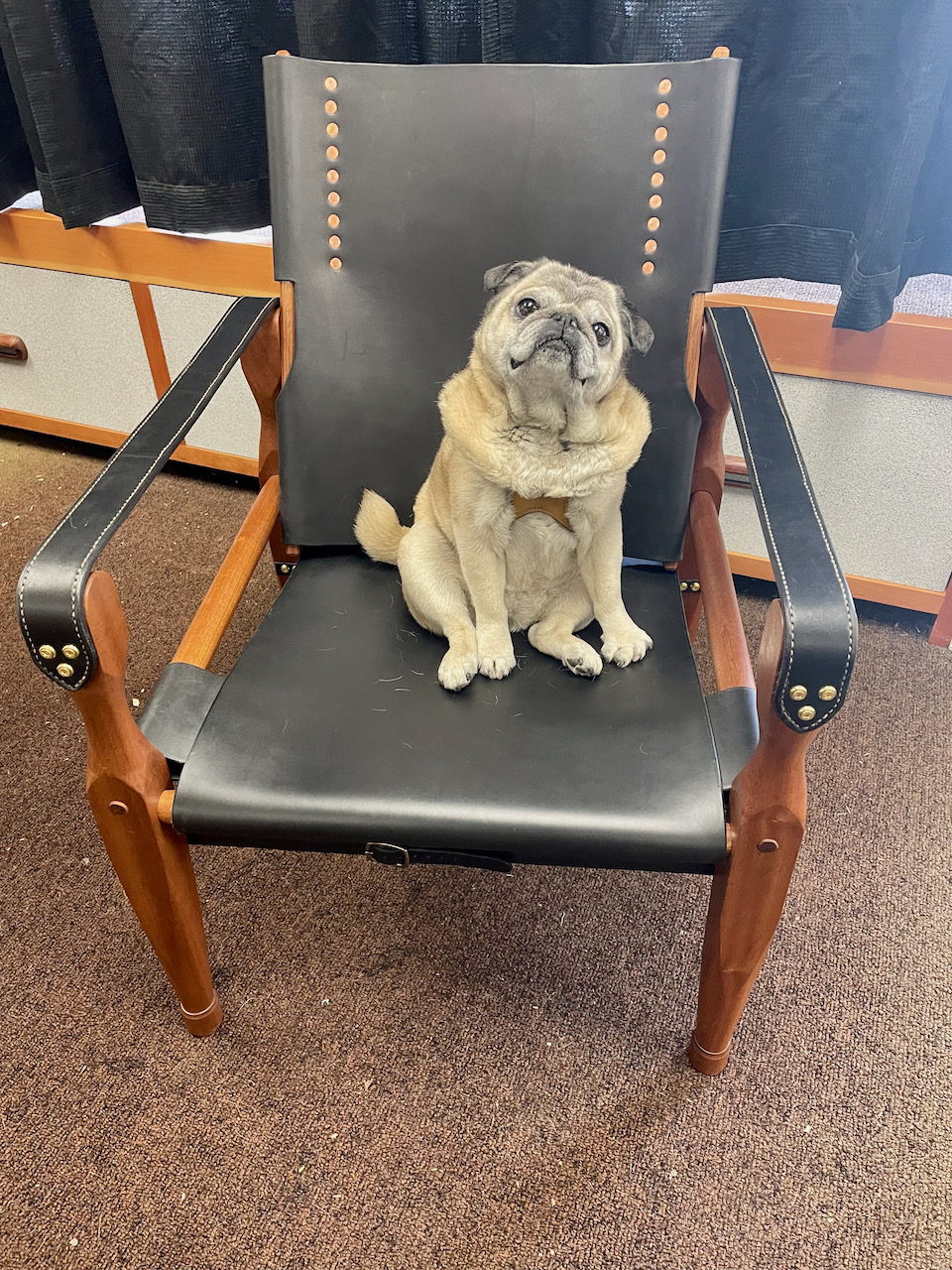
Peggy Tzu, my most experienced chair model, shows off my favorite design, the Roorkhee chair.

That’s the topic of consideration for the next meeting of The Lumber Support Group (aka Shop Stewards) of the Phinney Neighborhood Association Community Woodshop.  The Roorkhee chair pictured above is my idea of a good design, leaving the question of why is it good?

My views on design are largely the product of my woodworking (and life) apprenticeship with my father.  Pop was a mechanical engineer by training and for him good design was almost completely a matter of ‘form follows function’.  Therefore whichever form best fits (follows) the function of an item is a good design.  So if we kick this can down the road far enough, we come to the ultimate question,  what is the function?

Obviously the first function of a chair would to be a comfortable place to sit.  I submit that everyone whom I have invited to sit in this chair has found it very comfortable, both immediately and over time.  I consider the thigh strap across the front of the seat sling a key feature to that purpose.  Kris has sat in one comfortably for over four hours.

Another function of the chair would to be conveniently portable.  In this case, the chair is easily moved with one hand over a short distance, thanks to the hourglass like shape of the legs.  It also has the added feature of being quickly disassembled and packed in a bag for travel.

But perhaps the most unique feature of this chair is its ability to adjust to uneven ground (or floors).  This is because all the mortise and tenon joints are conical; they are held in place with straps and buckles.  The joints rotate to automatically adjust to whatever surface it’s placed upon and it neither tips nor teeters.  Although the chair performs these narrowly specified functions well, it is nevertheless not a good design for sitting at a table,  as it sits too low and reclines too far.

The one function not easily defined is the chair’s aesthetic value.  Given that ‘there is no accounting for taste’,  it may well be impossible to objectively assess.  My father would occasionally praise an elegant solution to a problem.  And while the skeptic might argue that ‘elegance’ is synonymous with ‘efficient’ to an engineer, I think he would have agreed that not all efficient designs are aesthetically pleasing.

Perhaps ‘good design’ is simply something that inspires consensus of opinion.  On the other hand maybe it inspires debate.  I guess it all depends upon its function.

*BTW- The modern renaissance of the Roorkhee chair is entirely due to the efforts of Chris Schwarz who has taught hundreds to make them (including myself), and has freely shared his design and expertise.


On growing older, mistaken assumptions and dismissing principles

Whoo boy!  Okay, there is a lot to unpack here so let’s get started.

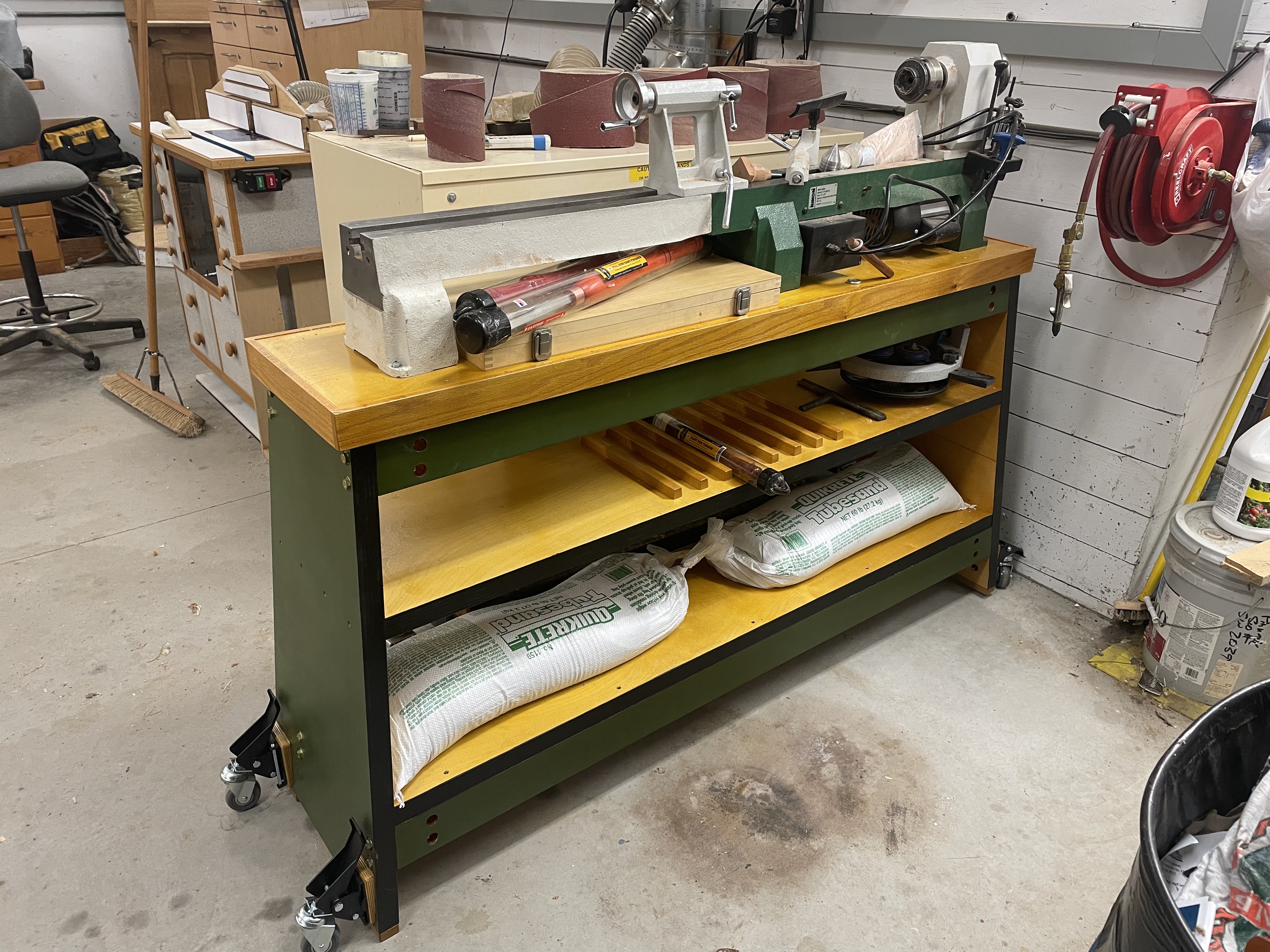
When I finished making gnomes and walking sticks for the year, I disassembled my bench top lathe and stowed it under the workbench.  The biggest part of the lathe is roughly eighty pounds so I have officially given up trying to lift it up to the bench myself.  Gone are the days when I could carry three, fifty pound feed sacks on my shoulder (I really could, honest). So I decided to build a permanent lathe stand. So much for growing older.

A8F4FFBD-C360-494C-8E5B-E4486E9B7778

The design is from an old Popular Woodworking article called, “The Ultimate Lathe Stand”.  I’m not sure what makes it ‘ultimate’, other than the fact that it is likely to be the last lathe stand that I ever make.  The two distinct and defining features of this design are that it is made of Baltic Birch multi-ply plywood and it uses a unique bolt together fastening system.

Multi-ply has thirteen plies, while regular plywood has only seven.  The effect of this difference is staggering, particularly when you try to pick up a sheet of 3/4″ multi-ply; it is incredibly heavy compared with regular 3/4″ plywood.  Regular plywood is heavy enough at 3/4″ to require most people to request help or employ some device for transport.  Multi-ply is over twice as heavy.  The weight is necessary for the stand in order to overcome the vibrations caused by out of balance turning pieces, before they are trued up and balanced for turning to shape.

I went to my local lumber yard to order the plywood and requested delivery, partly because of the weight and partly because I can’t fit a whole 4’x8′ sheet of plywood in my car, let alone three sheets.  I was reminded at the store that Baltic Birch sheets are roughly 5’x5′ (they’re metric).  As my longest component was 63″, the Baltic Birch would not be large enough.  The guy at the counter suggested a domestic birch plywood that was 4’x8′.  The domestic product is known as Apple-Ply and is also a multi-ply, so I asked if it was Apple-Ply.  He said, “Yeah”, so I said, “Sure go ahead and substitute with the domestic stuff”.  Well, when it arrived it was something called, “shop birch” and was seven plies, not thirteen.  Apparently the counter clerk didn’t know what Apple-Ply was and was embarrassed to admit it.  As I had to call in a favor to get the delivery, I didn’t feel like I could send it back and told myself that the weight wouldn’t be missed, as my lathe was a smaller bench model.  So much for mistaken assumptions.

The second feature, the unique fastening system, uses through bolts to connect the end legs to the ends of the connecting beams.  The bolts are secured with nuts in cross bored holes lined with copper pipe for strength.  Because the tension on the bolts can be spread over half the circumference of the pipe, they can be tightened down extremely tight.  This is expected to make the joint secure against vibrations and wracking loads.  The thing is, I’ve never been comfortable with fastener joinery, that is joinery that relies on the fastener to act in shear as well as tension.  My training suggests that joints should rely on mortice and tenon or other such classic joinery to hold pieces in shear; fasteners (screws, bolts, etc.) should only be expected to provide tension.  However, expediency, laziness and the description in the article worked to convince me to give it a try.  So much for the dismissal of principles.

Only time will tell if the joinery will withstand the vibrations and if the plywood is heavy enough for the project to be a success.  In any case, I think that this will be my ultimate lathe stand.

A wormy tabouret

How do you value the opportunity to work with irreplaceable wood?  A while back, I was given the gift of some reclaimed wormy American Chestnut.  Incidentally, all wormy American Chestnut is reclaimed because the species was wiped out in a blight by the 1940’s.  So the gift represents a once in a lifetime opportunity. My first project using the wood was a keepsake box made as a thank you gift.  My next was one of my favorite designs, the Limbert tabouret #238.  I usually use quarter sawn white oak for this design but thought that the wormy chestnut would be shown off to good effect.

CEE8E5CE-5E4A-4D82-AF01-48421655D056

My best work has always been done when I spend the money for the best material available.  The higher the investment, the greater the care I have applied to completing the project.  This material presented a new pressure, in that there were no do overs if mistakes were made.  The results are something I am both proud of and grateful for .

Bentwood Box Class

Hey folks,

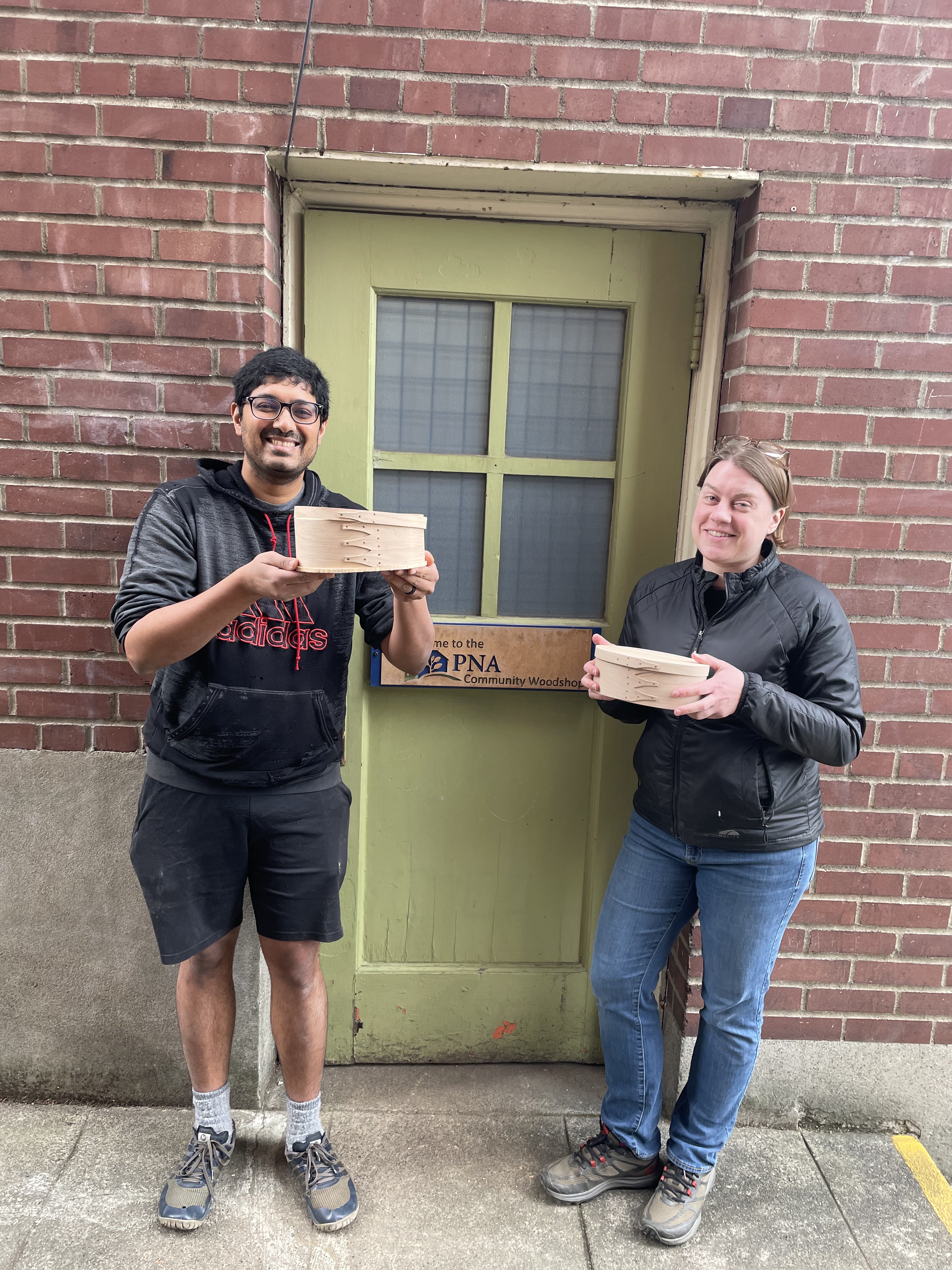
For a weekend at least, I’m back to teaching Shaker bentwood box building; this time at the PNA (Phinney Neighborhood Association).  Although we only had two four hour sessions, both students were eventually able to make two boxes, sizes #3 & #4.

fullsizeoutput_3c3

The first part of day one was spent learning how to use the combination disk and belt sander as a stroke sander for tapering the bands for the box and lid.  Next came cutting and beveling the “fingers” of the lap closure, clench nailing on the pipe anvil and, of course, bending the bands using boiling hot water.

The next day, after the bent bands had cooled and dried on the forms, the students learned the basics of bandsaw use and safety before cutting out the plug ends for the bottom of the box and top of the lid. After some final sanding to shape, the plugs were then fitted and pegged to the bands. A little finish sanding, and the the boxes were complete and ready for paint, or wax, or nothing as the builder preferred.

A28D3062-F5CB-4FA5-9D5A-BEE89BBBB235

In all, it was good to get back to teaching.  I really enjoy sharing that sense of accomplishment that my students feel when they’ve mastered a new skill.  I hope to teach some more in the near future.

Once more into the vortex

Hey Folks,

It’s approaching that time again, wherein I drag the lathe out from under the bench and enter the vortex of wood turning. I call it the vortex because as it spins it tends to draw you in with instant gratification, causing you to forget about any other type of wood work. My annual entry into the abyss usually coincides with the approach of the holidays and my lack of any otherwise meaningful woodworking gifts.

In the past, I have made Christmas nutcrackers, snowmen and mice (think Nutcracker nemesis). Last year, the fad all over the internet was gnomes. I tried to avoid contributing to the hype, but his year I’ve run out of excuses.

Turned gnomes tend to be nearly featureless, hatted and hairy. I say “nearly” featureless as they have one distinctive feature, that being a prominent proboscis.

My gnomes are made of cherry, with hats of sapele, or bubinga and noses of cherry or sapele. Since there are dozens of YouTube videos available demonstrating how to turn them, I’ll limit my how-to discussion to making ordinary gnomes into holiday gnomes with a holly sprig hat badge.

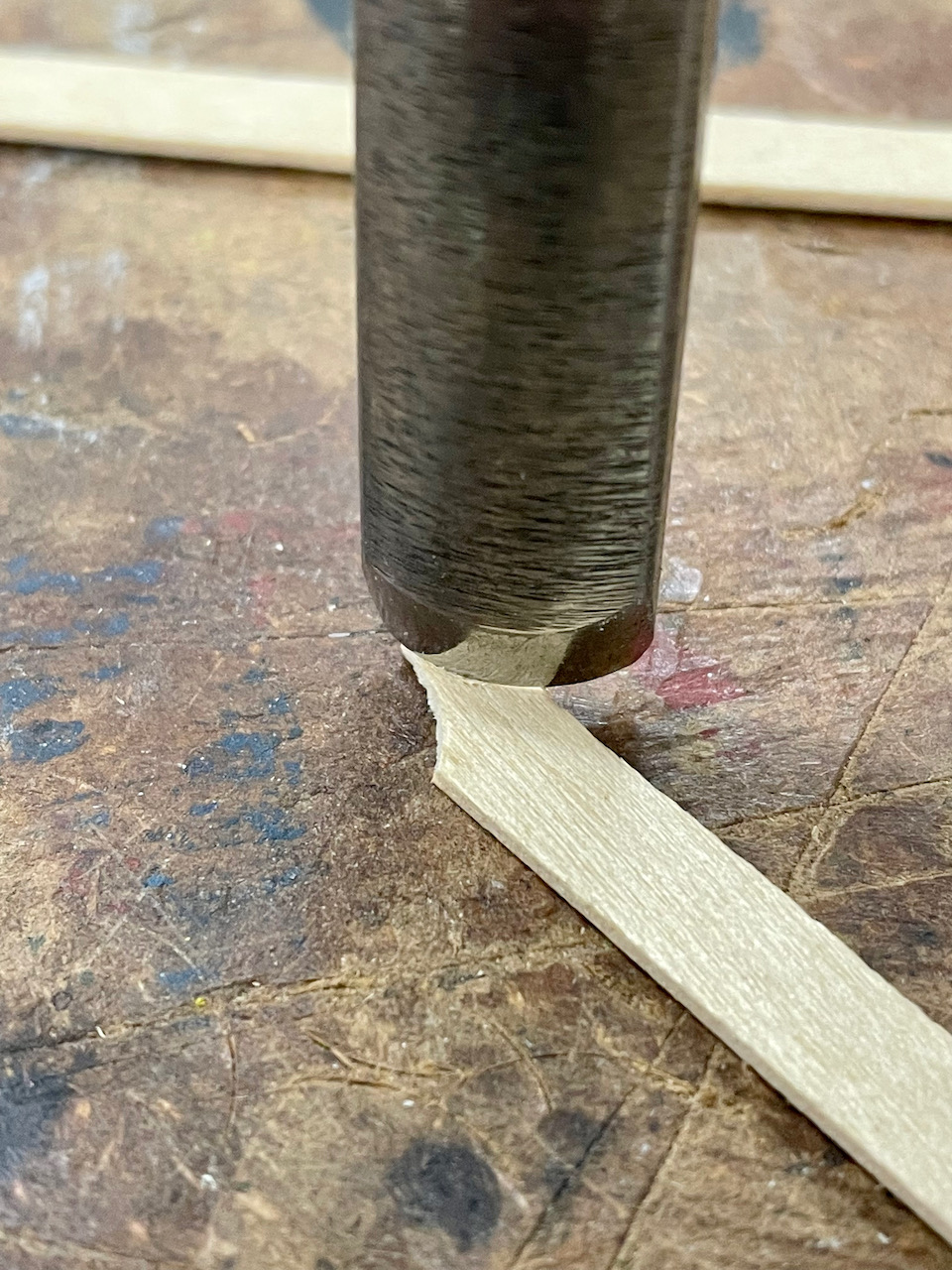
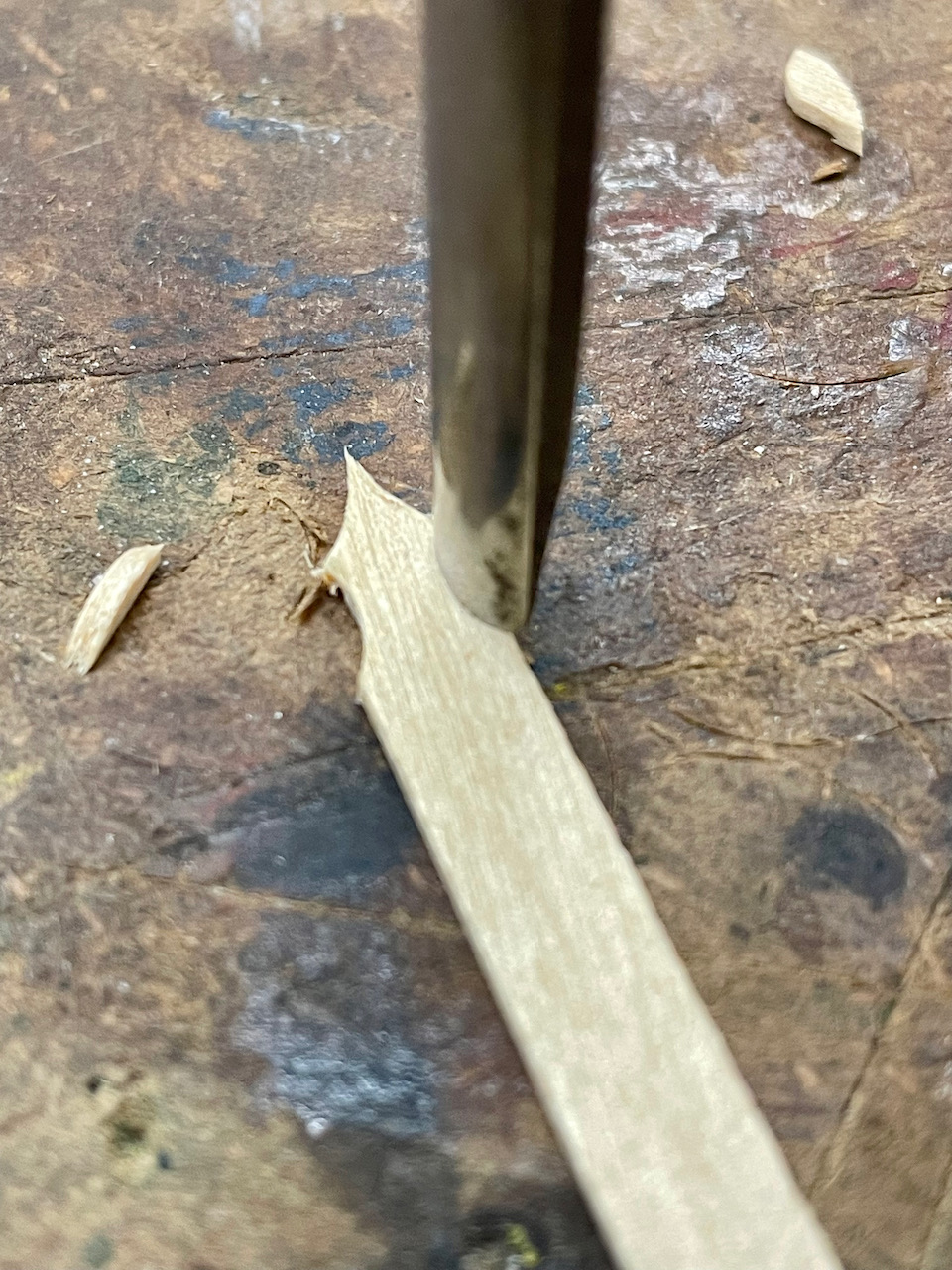
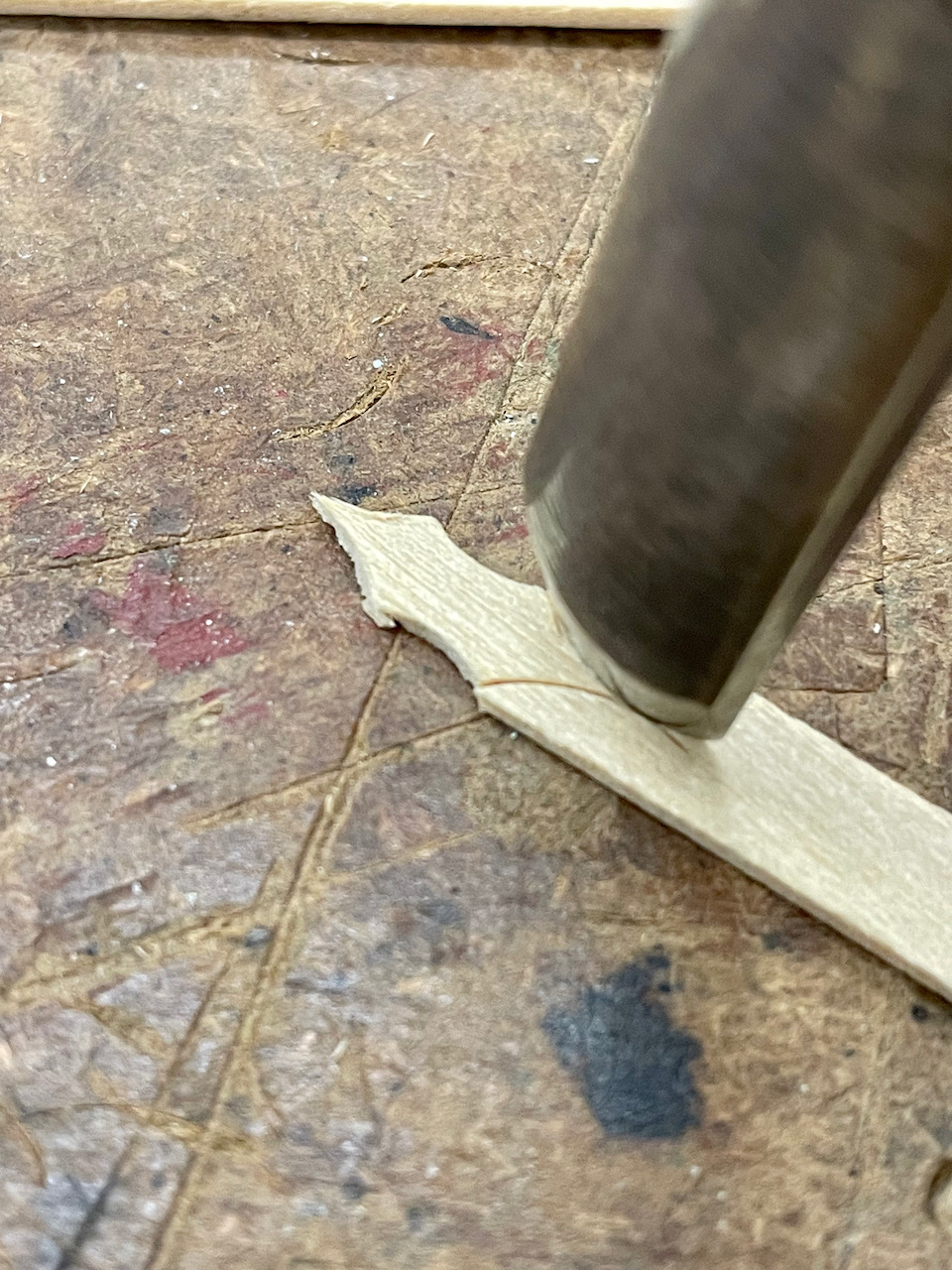
First, pick up a few wooden coffee stirrers from your local barista. Then cut the tip using a sharp gouge (a #7 in this case). The side cuts were made with a slightly tighter curved gouge. A little paint and some Duco™ cement, and the badge is finished. One note: I do paint the holly berries after the leaves are glued in place as they are easier to handle then.

I have a few more to make before I can comfortably say I’ve met my Christmas quota so some variation in woods and beards may be in store.

Cheers,
Tom

What goes around, comes around

If you follow this blog, you may remember that I wrote of receiving An Unexpected Christmas Gift last December, wherein I described a gift of wormy American chestnut. Since wormy wood is nearly always from dead or moribund trees it is thus often unpredictable in terms of its hardness and integrity. Fortunately, the gifted wood was in good shape and I was able to make a reciprocal gift from it.

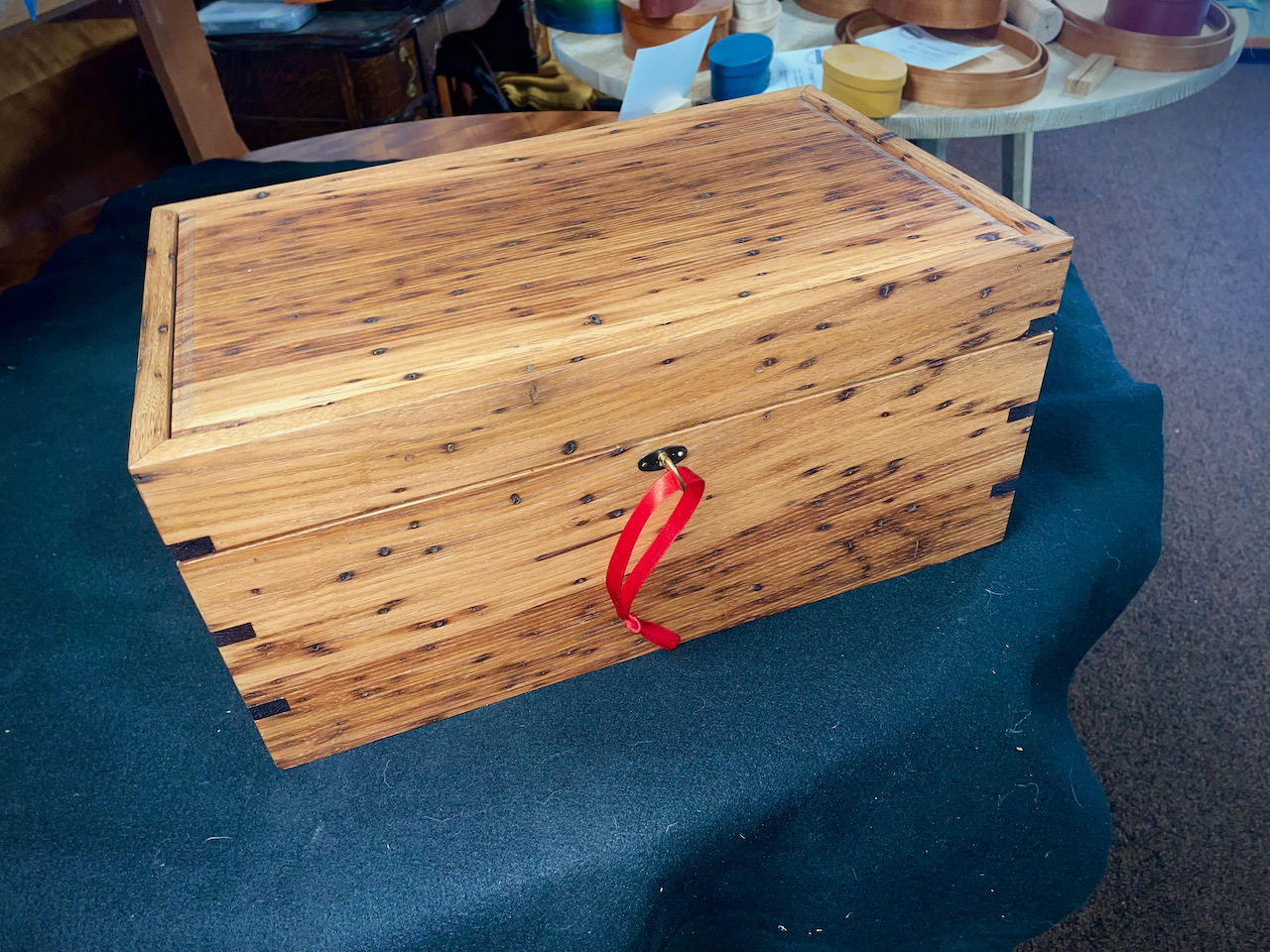
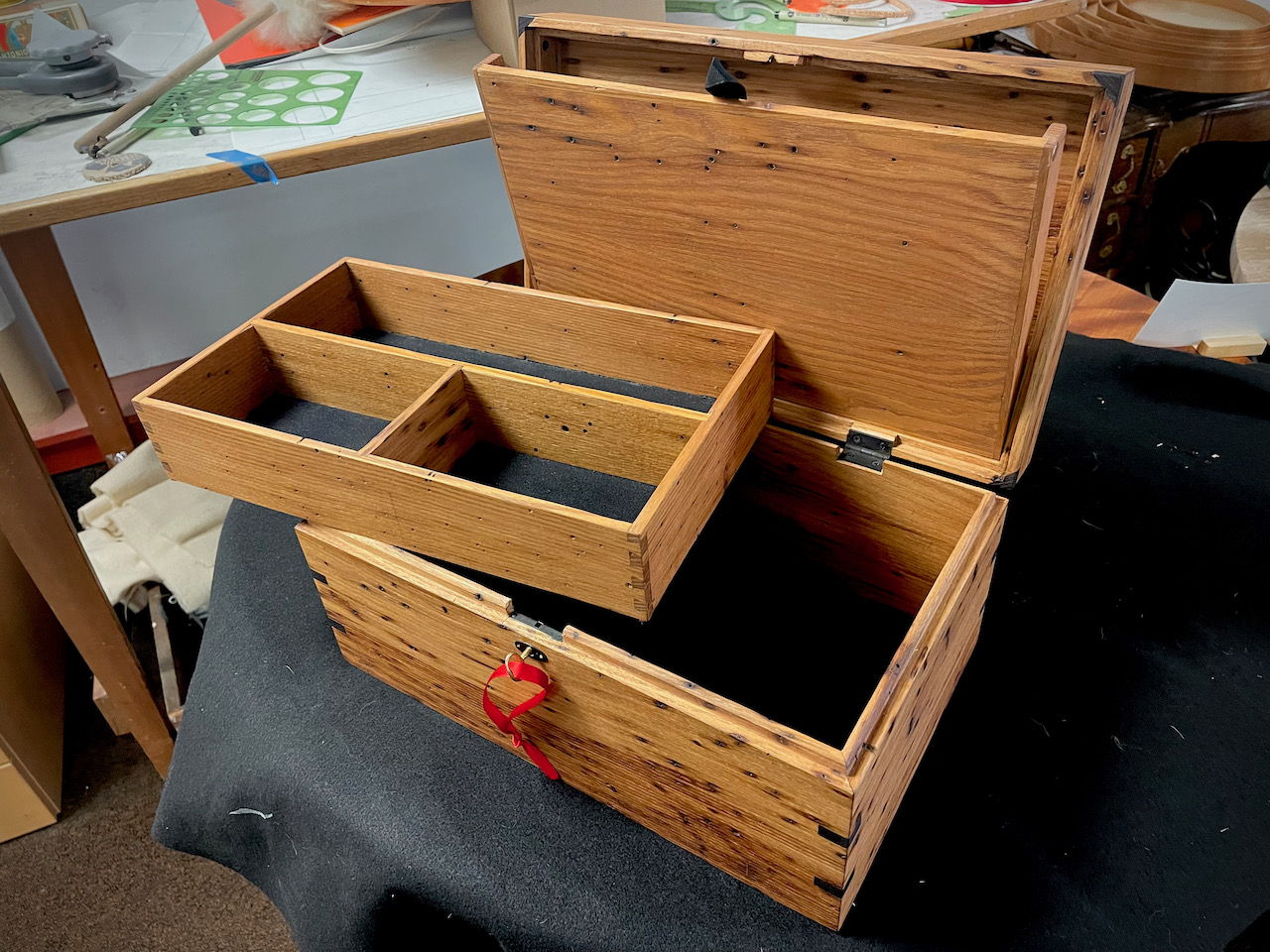
I decided on a keepsake box as a memorial to the gentleman whose bookcase provided the lumber.

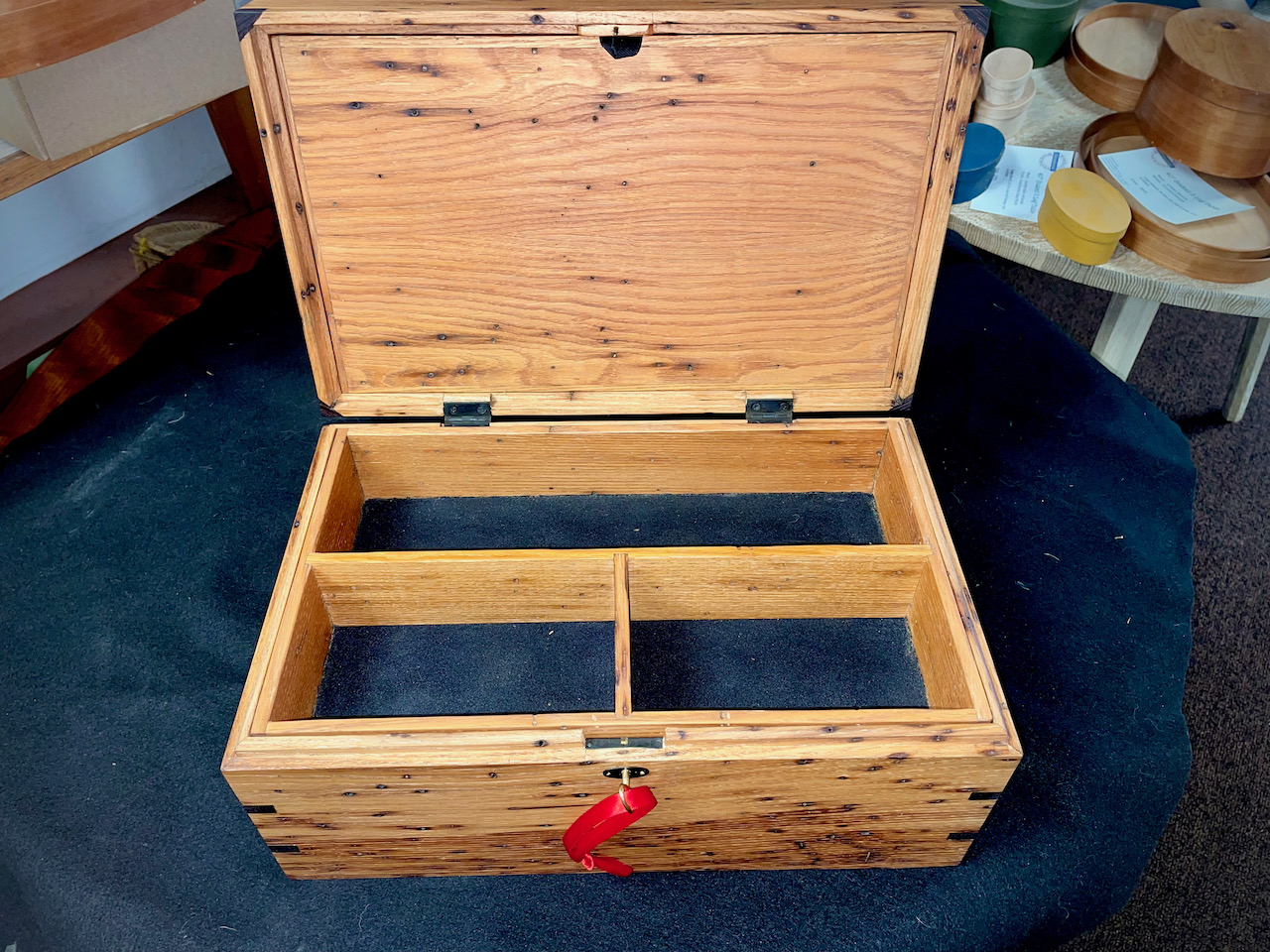
The box measures 10 x 16 x 6 inches. The corners are simple miters, reinforced with wenge keys. The top is a telescopic fit, modified for hinges and a latch. The brass hardware is chemically blackened to match the natural colors of the wood.

Inside, there is a lift out till, divided into three compartments. The bottoms of the till and the box are coated with black velvet flocking.

In the lid is a compartment for photos and letters.

The entire box is finished with Anarchist’s Daughter Soft Wax™ (linseed oil/beeswax)and buffed with a brown paper bag (You read that right, and it works great! Try it sometime). The finish is ideal for objects that will be touched, as I hope this one will be, often.

Bon Voyage Mon Cher(Chair)

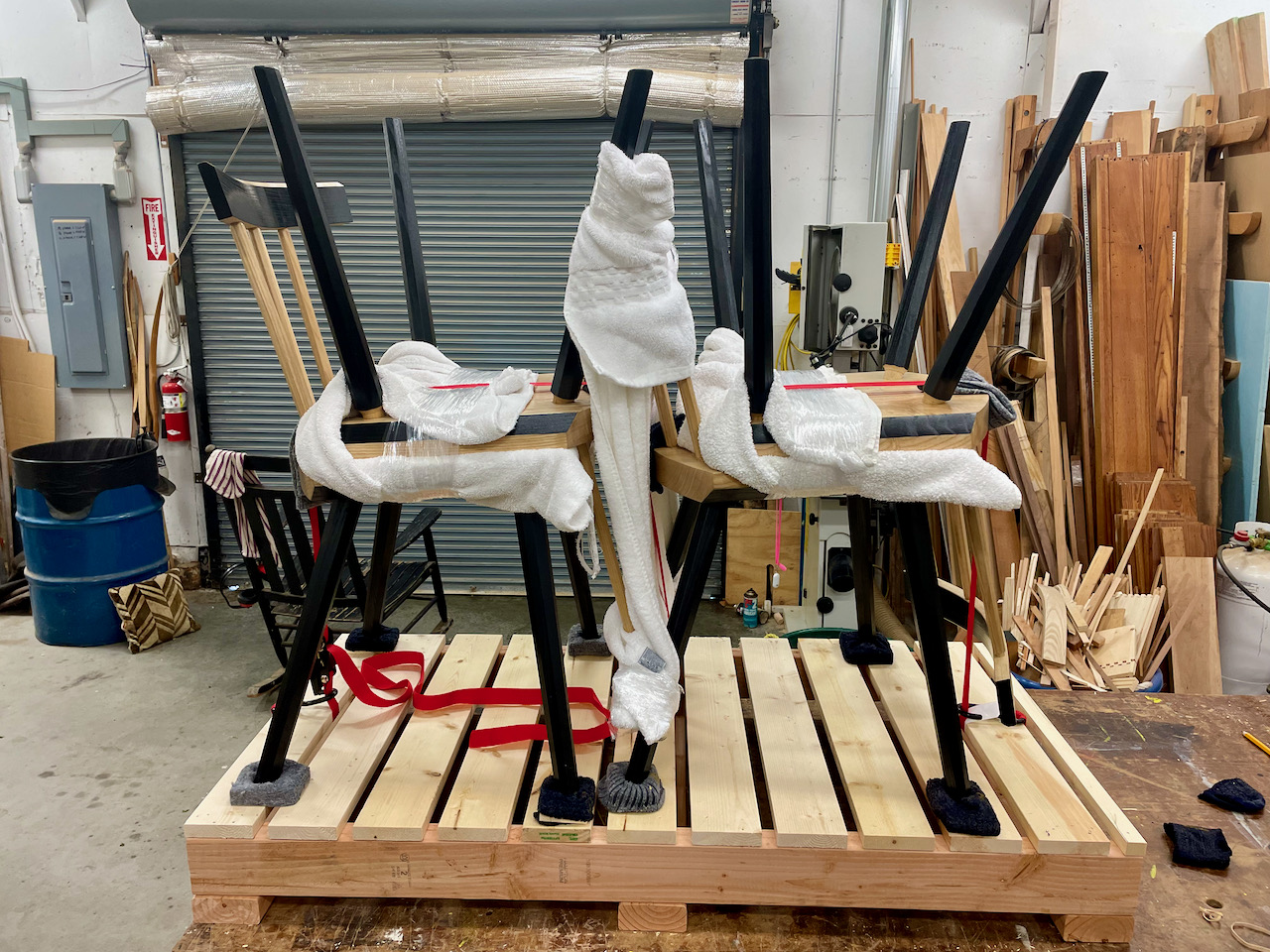
Sometimes you have to say goodbye. The staked leg dining chairs that I made in the image of the Chais d’Enfer have departed for points east. They are a wedding gift for my youngest nephew and his bride.

Not having ever shipped any of my furniture before, I was a bit apprehensive as to how I should prepare them. Should I do a full crate, a pallet, or a sheathed pallet? How do I best protect them from chafe?

I ended up building a pallet and creating some sockets padded with old wool socks (does that make them sock-ettes?) and fastening them to the pallet deck. I then padded the chairs with some old towels and bound them with plastic stretch wrap. The whole assembly was secured to the pallet with a ratchet strap, and finally covered with a moving blanket and wrapped completely in wider stretch wrap.

I was relieved to hear that they arrived across the country in good shape, so I can bid adieu to my four little creations.

Cheers,
Tom

PS. At the rehearsal dinner, my nephew was awed that I built the pallet (sigh). Sometimes creations are just their own reward.

Signs of Spring

Sure signs of Spring are showing up at the shop.

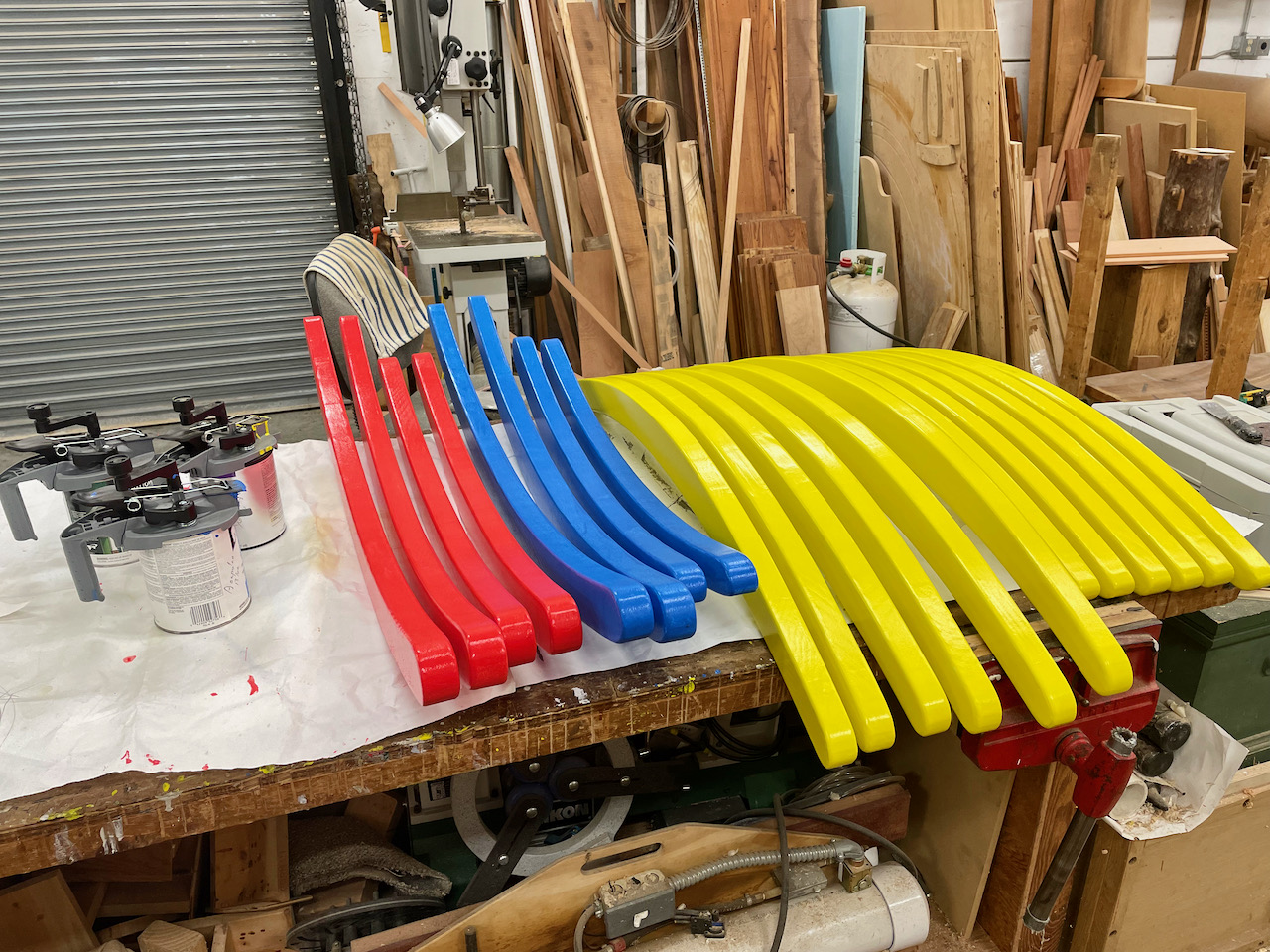
Apple blossoms are budding, artichokes are sprouting, the yard (weeds) needs mowing, and outdoor chairs are getting their first coat of color. As usual, we have Insignia Yellow, Acapulco Blue, and Alarm Red. The first of these should be ready for sale by the end of the week, thanks to some reserved parts from my last production run. Which was by the way, just after the start of the pandemic in 2020. It’s hard to believe that it was so long ago.

Cheers,
Tom

Merry Christmas (finally)

Sometimes things just take longer than planned.

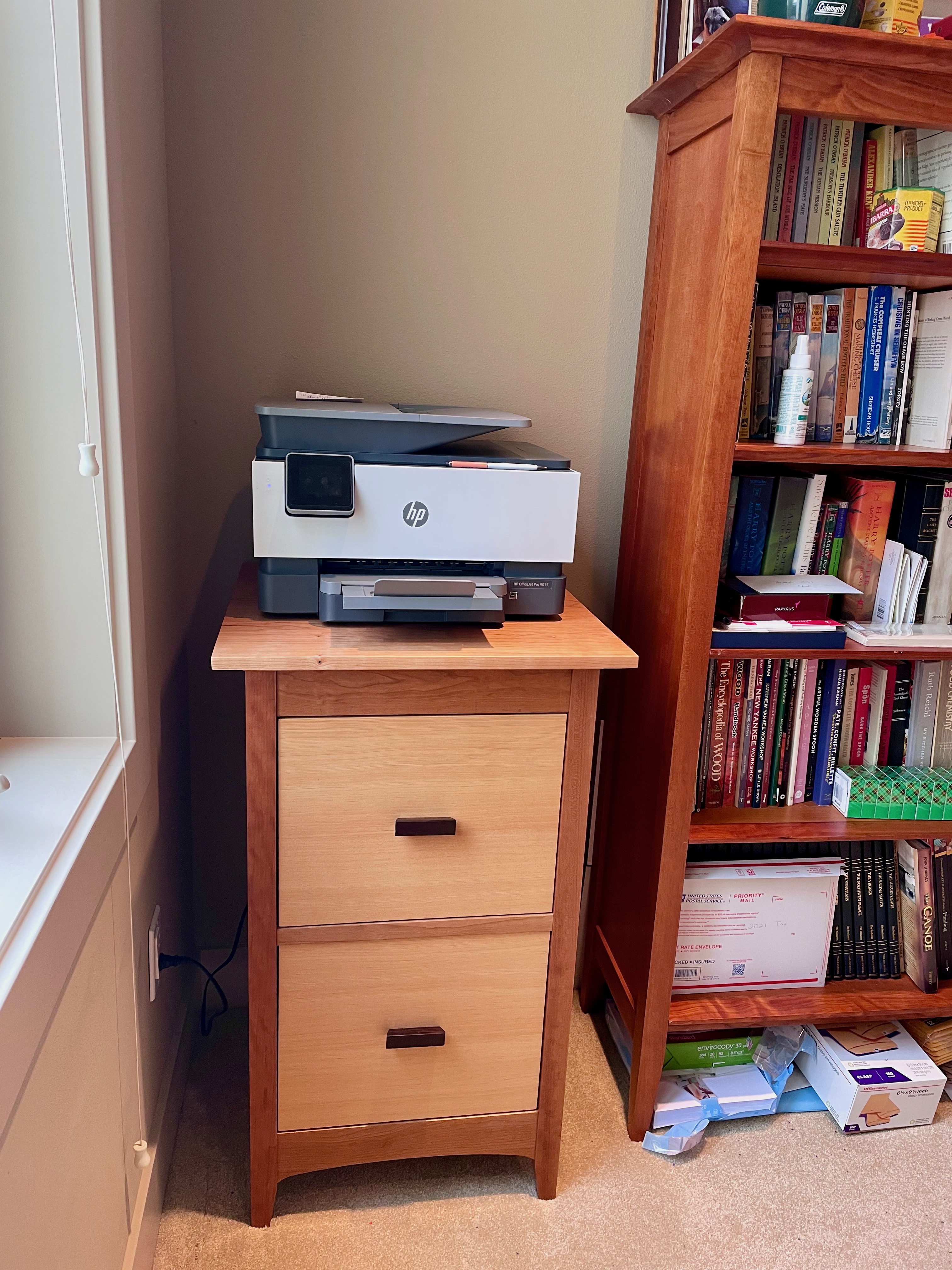
Case in point, Kris’ long awaited file cabinet which was promised for Christmas, …two years ago. I should correct myself, it’s not that it took two years to build, but that it took two years to get around to it.

Procrastination and performance anxiety (fear of failure) are powerful forces that most of us try to ignore, that is until they smack you upside the head. In my case, I generally dread designing anything. Too often, my method of design requires a lot of trial and error. Too much error, and I get discouraged and set things aside to further ruminate upon how to proceed. I also know that if I start a new project while setting aside a problem project, the problem will never be resolved. Therefore everything comes to a halt whilst denial and sulking take their toll on my productivity. Often during these periods of stagnation I turn to the kitchen to relieve my creative urges, that is until Kris has had enough of my messing about and gently encourages (relentlessly shames) me back to the shop.

The file cabinet started as a mock up, as do most of my projects, which revealed a number of design flaws and procedural errors. Thus followed a period of sulking and self doubt that resulted in a number of kitchen forays into the culinary unknown. Eventually, failure in the kitchen became more embarrassing than failure in the shop, so back the the shop I went.

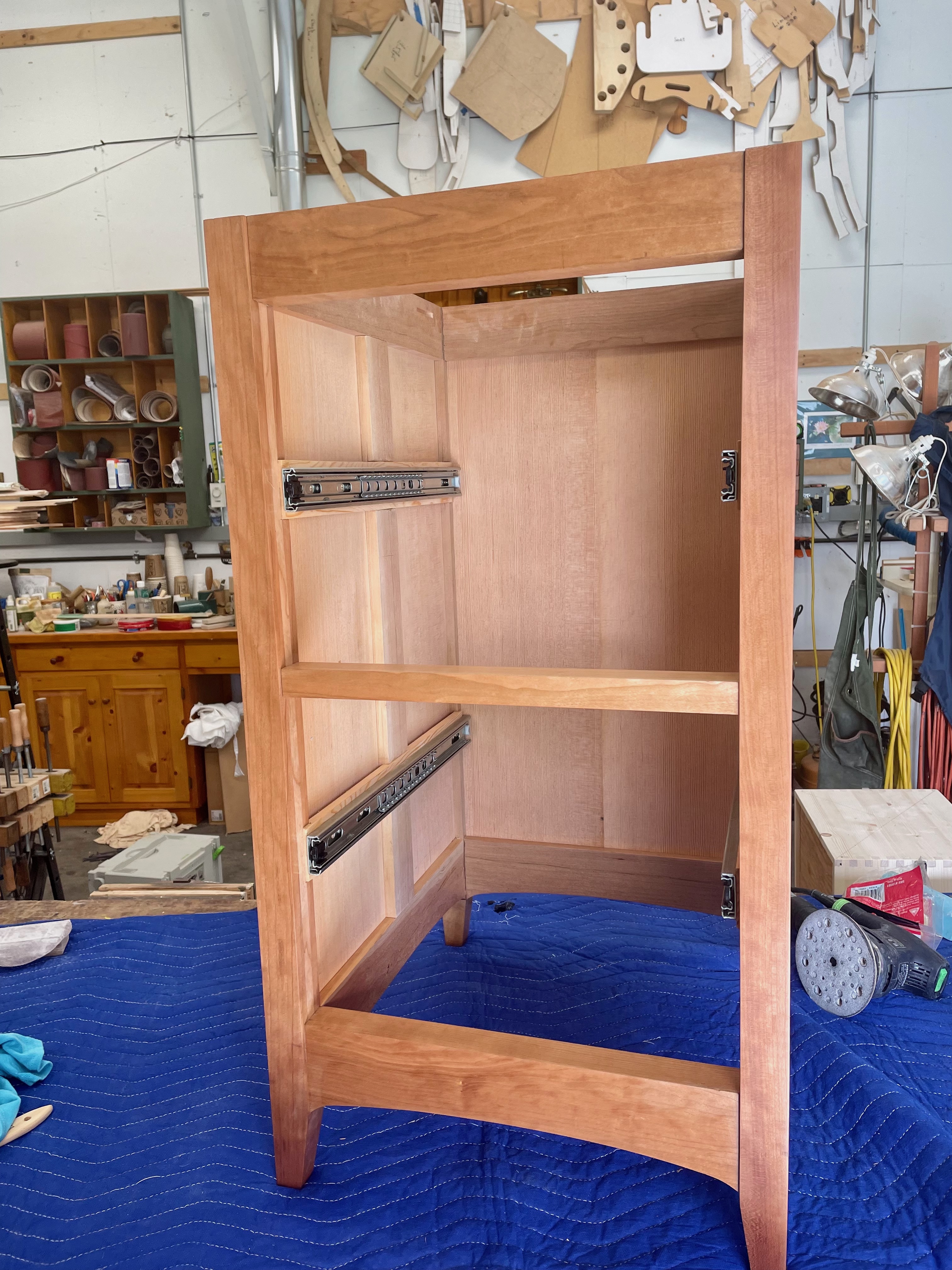
The resulting file cabinet is a companion piece to the bookcase pictured above. Both pieces are frame and panel construction with cherry and douglas fir (the pulls are wenge). It’s hard to imagine, but the file cabinet will eventually darken with age to match the bookcase perfectly. The cherry will redden and the doug fir will change from pink, to a burnt orange color. The patination of this cherry/doug fir combination is one of its more satisfying attributes and makes it fun to work with.

Now I have to choose from the number of projects that I’ve put off for the past two years.

Cheers,
Tom

An unexpected Christmas gift

Hey Folks,

Earlier this week I got an email out of the blue from a shop neighbor who said that she walks by my shop daily and looks in the window to see what’s new. She also mentioned that she was dismantling her father’s old library shelves that were made of Wormy American Chestnut …and would I like to have them?

Now, in case you’re unfamiliar with American Chestnut, it was one of our nation’s premier furniture woods up until sometime after 1904. That’s when an asian chestnut blight was introduced to North America and within 40 years, the American Chestnut population was wiped out.  Wormy Chestnut is caused by wood boring insects that infested dead and moribund trees.

So, as you may have gathered, they don’t make ’em any more and American Chestnut is only found now as reclaimed lumber, usually as Wormy Chestnut.

So far, my neighbor has given me over 65 board feet of free Wormy Chestnut. Most of it is an honest 1″ thick and some of the boards are 11″ wide. She says she’s still downsizing and may have more to donate.

I told her that I not only appreciate the gift but also the provenance and sentiment that goes with the remnants of her father’s library. She said that she was glad that I would be able to make something nice with it. I’m thinking some Limbert Taberets would be nice, perhaps also some boxes.

You never know when something nice will drop into your lap.

Merry Christmas!
Tom